
Microscope upgrade enables ENT training in Cameroon
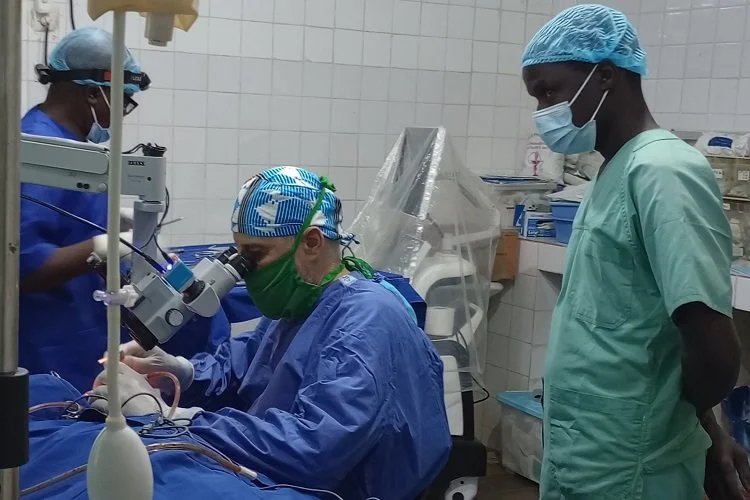
Dr Max Leßle teaching
Report by Dr Max Leßle on the conversion of the surgical microscope in Cameroon
The German association HNO für Kamerun e.V. (ENT for Cameroon) has been running an ENT department in Ngaoundéré, the provincial capital of Adamaoua in northern Cameroon, together with local partners for over 10 years.
After the first few years were devoted to establishing an effective medical and administrative structure to ensure optimal patient care under the given circumstances, the focus in recent years has increasingly shifted to training local staff.
One example of this is the conservative and surgical treatment of thyroid disorders, primarily large goitres. A total of four surgeons from the region have been trained, so that this field of activity has now been completely handed over to our Cameroonian colleagues.
We benefited from the fact that our colleagues already had basic surgical experience and that the surgical area is easily accessible.
The situation is different in the more ENT-specific areas of the nose and sinuses, the larynx and the middle ear.
The lack of diagnostic instruments such as endoscopes and microscopes means that, in addition to a lack of diagnostic expertise, there is also no surgical experience in the use of modern surgical techniques.
The use of video endoscopes has proven effective in training our staff to examine ears. However, the next step, surgical intervention, requires the use of surgical microscopes equipped with a device for an observer.
For many years, we have been using an old but very robust surgical microscope from ZEISS in our operating theatre. This has enabled us to perform all essential procedures on the larynx and ear. However, due to the lack of a second observer attachment, it was not possible to provide adequate training in this area.
This led to contact with Prechtl TechSolutions. Impressed by the innovative design of the portable microscopes and the many positive reviews from users in developing countries, we got in touch with Mr Prechtl to find a suitable solution for our setup.
It quickly became clear that we did not need to purchase a new microscope and, as we no longer needed to be mobile, we could fall back on our solid ZEISS system.
The following modifications were then carried out:
The ZEISS OPMI 9-FC head was retained, as were the arm and the stand.
The light source was converted to an SPOT 19-FC LED light source.
The binocular tube was replaced with a more powerful used binocular with a focal length of f=170.
A new pair of 12.5x/18B eyepieces was installed.
A Zeiss video adapter with a focal length of f=74mm was used, to which an Ultra HD 4K 1080P video camera was connected.
An HDMI transmitter and the necessary cables and adapters were also added.
All components were provided to us by Prechtl TechSolutions after intensive telephone consultation and the exchange of photos. The components were transported by our volunteer doctors in their hand luggage during visits to Cameroon. This proved to be a successful approach, as there were no problems with customs clearance in the destination country.
The new components were assembled with the existing parts on site. Thanks to the modular design of all components, including the ZEISS microscope, which is already many years old, the assembly is not a technical challenge and does not require any special tools.
In spring 2025, we were able to put the microscope into operation for the first time in its new configuration. After some fine-tuning, the first teaching operations began in autumn 2025.
The system proved to be very stable and powerful.
Only the HDMI wireless transmission tended to fail (which may be due to the monitor), which is why we implemented the transmission to the monitor with a sufficiently long HDMI cable.
Similarly, the monitor, which is designed for an endoscopy system, shows weaknesses in colour reproduction and in the compensation of strong contrasts. A more powerful monitor is to be used in future to remedy this.
Thanks to the excellent cooperation and innovative strength of Prechtl TechSolutions, we were able to build on an existing surgical microscope to achieve a technical improvement to the microscope and the possibility of "on-hand" training in microsurgery of the ear and larynx.
All these measures were implemented at a price that was only a fraction of what would have been required for a new purchase!